
Documents
180,000 Shrapnel Fragments: Engineering a War Crime When Lamard becomes the testing ground for a new U.S. weapon

While International Humanitarian Law (IHL) consistently emphasizes the protection of civilians in armed conflicts, recent revelations have uncovered a harrowing reality: the use of a cutting-edge, devastating weapon by the United States in the city of Lamard—a civilian environment, not a military target.
In the initial days of the aggression against Iran, the U.S. military deployed a new, advanced surface-to-surface ballistic missile known as the PrSM (Precision Strike Missile) to target locations in the city of Lamard, in Fars Province. This marked the first operational deployment of this weapon system in a real-world combat theater. The missile is engineered to detonate precisely above its target, with a warhead containing approximately 180,000 tiny shrapnel fragments. Upon detonation, these fragments are dispersed in a lethal “rain” over a wide area to maximize damage to personnel and infrastructure.
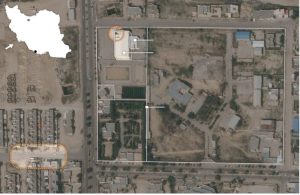
According to reports from The New York Times and BBC’s investigative unit, the missile struck a sports complex and an adjacent primary school in Lamard. Field footage and CCTV recordings, analyzed by experts, reveal “dense, microscopic perforation patterns” on the walls and roofs of these buildings, which perfectly match the dispersal signature of the PrSM munition. This indiscriminate attack resulted in the martyrdom of at least 21 civilians.
The First Deployment: Beyond a Mere Test
Documented reports suggest that the events in Lamard were not a routine military operation; rather, they constituted the “first operational use” of this new weapon. By selecting this specific geography for its maiden field test, the United States effectively transformed the area into a laboratory to gauge the lethality of its weaponry.
A Flagrant Violation of the “Principle of Distinction”
A cornerstone of IHL is the “Principle of Distinction” between combatants and civilians. Launching a weapon that disperses 180,000 fragments across an area constitutes an intentional disregard for this principle. When a weapon with such a massive blast radius and projectile density is deployed in a civilian zone, distinguishing between a military target and local inhabitants becomes practically impossible.
The use or testing of a weapon inherently possessing wide-area dispersal or uncontrollable destruction capabilities in a civilian environment creates a severe threat to the lives and safety of residents and, from a legal perspective, constitutes a serious breach of the laws of war. Such characteristics—even if not categorized as a “weapon of mass destruction”—render the use or testing of such munitions in civilian areas a war crime.
Breach of the “Principle of Military Necessity”
In the Lamard catastrophe, targeting facilities such as a school and a sports complex—which, by their nature, location, and function, offer no effective contribution to military action—was a clear transgression of the limits of military necessity. By disregarding this principle, the U.S. military deviated from its stated goal of engaging military forces, replacing legal necessity with “retaliatory” or “experimental” motives, thereby targeting civilian infrastructure.
Violation of the “Principle of Precaution in Attack”
The “Principle of Precaution in Attack” mandates that commanders take all feasible precautions to avoid, or in any event to minimize, incidental loss of civilian life. The deployment of the PrSM missile in the urban fabric of Lamard is a blatant and conscious violation of this principle. Choosing a weapon that, through an airburst, showers a neighborhood with 180,000 projectiles is fundamentally incompatible with the duty of precaution. The attacker, fully aware of the weapon’s wide-area lethality, failed to take any measures to protect the lives of children and citizens, deliberately choosing a method where innocent lives were sacrificed to test the weapon’s destructive power.
Infringement of the “Principle of Proportionality”
The “Principle of Proportionality” is a fundamental criterion of legitimacy in international humanitarian law, prohibiting any attack that causes disproportionate civilian harm. In the Lamard incident, even assuming the existence of a hypothetical military target, the death of 21 civilians and the widespread destruction of educational and sports facilities through the use of advanced PrSM munitions constitute a clear case of gross disproportion. This manifest violation demonstrates that the operation was conducted without any assessment of the balance between necessity and consequence, and therefore, under international law, it qualifies as a war crime.
The uncertainties are many, but the questions are clear: Why was such a weapon deployed in a civilian zone without warning? And which independent body is to investigate these crimes?